Case Study
SwachhNagar
A civic tech platform for smart waste management — enabling real-time garbage tracking, citizen complaint routing, and route optimization for municipal corporations. Built for Smart India Hackathon 2024.
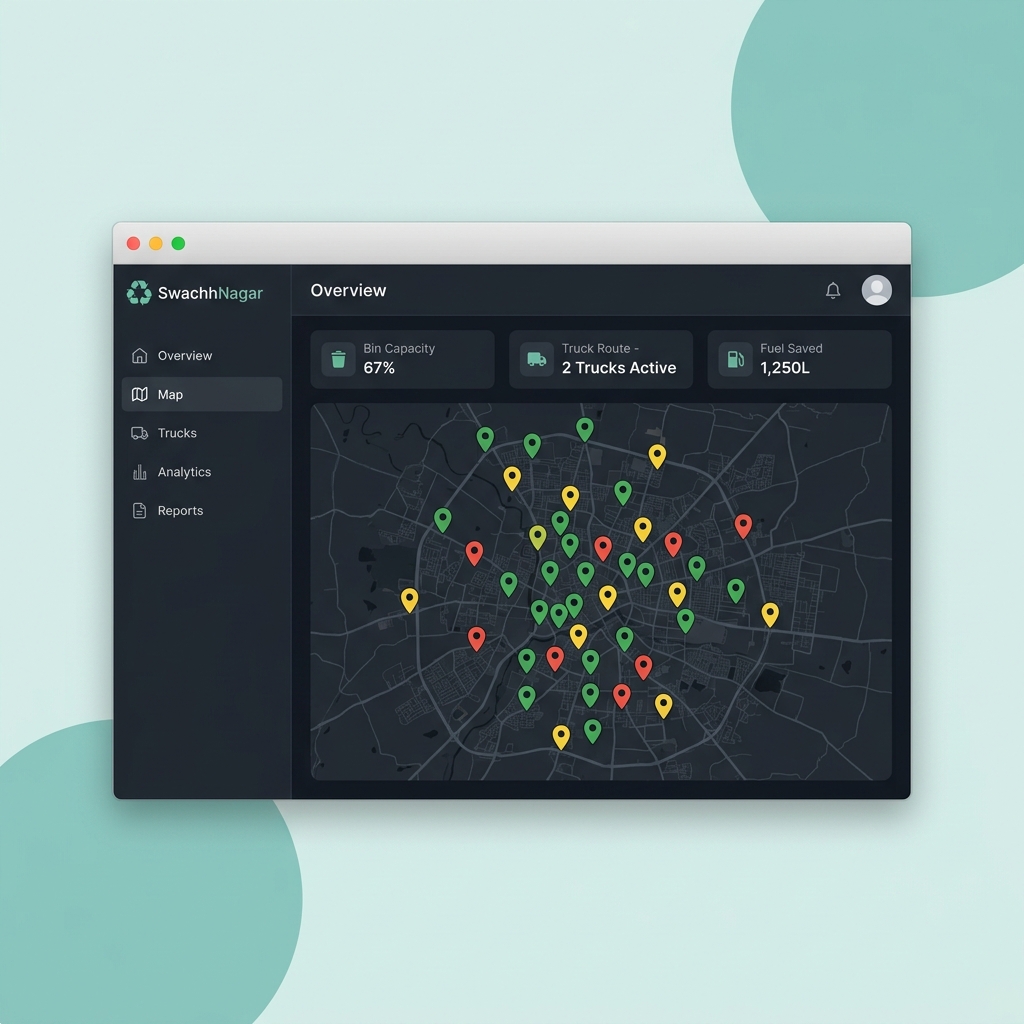
SwachhNagar dashboard — real-time garbage tracking, complaint management, and collection route optimization
01 — Problem
India's Waste Management Crisis
Municipal corporations across India struggle with inefficient garbage collection routes, zero visibility into collection status, and an avalanche of untracked citizen complaints. Citizens have no way to know when their garbage will be collected, and corporations have no real-time data on where their vehicles are or which areas are overloaded.
No Route Visibility
Garbage collection crews follow fixed paper routes with no optimization — leading to missed areas and redundant trips.
Lost Complaints
Citizens call helplines that log complaints on paper — with no tracking, no escalation, and no accountability for resolution.
Zero Real-Time Data
Municipal admins have no live map of collection status, vehicle positions, or hotspot zones that need urgent attention.
No Citizen Feedback Loop
After filing a complaint, citizens receive zero updates — breeding distrust between municipalities and residents.
02 — Solution
Smart, Connected Waste Management
SwachhNagar connects citizens, collection crews, and municipal administrators on one platform — giving every stakeholder real-time visibility and automated workflows.
The platform has three distinct interfaces: a citizen portal for filing and tracking complaints, an admin dashboard for monitoring city-wide collection status and managing crews, and a crew mobile view showing optimized daily routes and assigned complaint pickups.
03 — Features
What SwachhNagar Does
Live Vehicle Tracking
GPS-based real-time tracking of collection vehicles on an interactive map. Admins see all vehicles, routes, and estimated arrival times at a glance.
Citizen Complaint System
Citizens can file garbage overflow complaints with location, photo, and description. Complaints are auto-routed to the nearest available crew with a ticket ID for tracking.
Route Optimization
Admin panel generates optimized daily routes for collection crews based on area density, complaint hotspots, and vehicle capacity — reducing fuel costs and missed pickups.
Real-Time Status Updates
Citizens receive live updates as their complaint progresses — Received → Assigned → In Progress → Resolved. No more calling helplines to check status.
Admin Analytics Dashboard
Municipal admins see zone-wise complaint heatmaps, collection efficiency metrics, crew performance, and daily/weekly trend charts.
Crew Mobile Interface
Collection crews get a simplified mobile view with their assigned route, complaint addresses, and one-tap status updates as they complete pickups.
04 — Tech Stack
Architecture & Technologies
Frontend
- React.js
- React Router
- Google Maps API
- Chart.js
- Tailwind CSS
Backend
- Node.js
- Express.js
- MongoDB Atlas
- Mongoose ORM
- JWT Auth
Infra & APIs
- Google Maps JS API
- Directions API
- Geolocation API
- Socket.io (live)
- Vercel Deploy
| Category | Technology | Why This Choice |
|---|---|---|
| Database | MongoDB Atlas | Flexible schema for complaint data with varying metadata; geospatial indexing for location queries |
| Maps | Google Maps JS API | Reliable in India with Directions + Distance Matrix APIs needed for route optimization |
| Real-time | Socket.io | WebSocket-based live updates for vehicle positions and complaint status without polling |
| Auth | JWT + Role-based | Three distinct user roles (citizen, crew, admin) with route-level permission guards |
| Frontend | React + Chart.js | Dynamic dashboard with real-time re-rendering; Chart.js for analytics visualizations |
05 — Challenges & Learnings
Hard Problems Solved
Real-Time Vehicle Tracking at Scale
Broadcasting GPS coordinates from multiple collection vehicles simultaneously to all connected admin dashboards without excessive server load was a key challenge.
Complaint Location Accuracy in Dense Urban Areas
Browser Geolocation API returns imprecise coordinates in dense urban areas — sometimes off by 200–300 meters — which could route crews to the wrong lane.
Route Optimization Within API Cost Limits
Google Directions API charges per request — generating optimized routes for 20+ daily stops per crew would cost significantly on a hackathon budget.
06 — Impact
What SwachhNagar Achieves
SwachhNagar transforms waste management from a disconnected, paper-based operation into a real-time, data-driven system. Municipal corporations gain visibility into their entire fleet and complaint backlog at a glance, while citizens get a transparent feedback loop for the first time.
This project deepened my skills in real-time systems with Socket.io, geospatial data handling with MongoDB, maps integration, and designing multi-role platforms where different user types need radically different interfaces from the same backend.